
Being a father seems to me a difficult task. And I don't mean the 'providing' part. It is not always clear how a child's experiences influence its behavior or personality. Maybe the prospect scares me even more because I live in the shadow of my own father, or his memories since he died in 1997.
For the most part, my father 'observed' me. It was unlike him to give me instructions. Mostly, he did what he could to create the right environment without appearing harsh to the pleasure-loving creature that a child is. Objects that provide entertainment but no learning had a difficult time finding their way into our home. Before classes started each year, we would sit down and put covers on textbooks. He did it like it was an art, finishing with writing my name on the front cover in a handwriting that would seem to have come from a printing press. He had won gold medals in Engineering for his Bachelors and Masters degrees. The standards were set as high as they could be, but never was a word uttered about any expectation of meeting them. I had once asked while watching Ivan Lendl play tennis with the usual tense expression on his face - is it important to play to win or to play happily? The answer came immediately - It is better to play happily. I didn't think that was necessarily right at that time, but now I see how personal ambition has brutalized humanity throughout history. Gentle hints came my way on rare occasions. He once asked me about the TV - Can't you overcome its attraction? I gave him a sheepish shrug.
Few words were exchanged between us. For the most part, he would seem aloof, and I might have been tempted to nurture that belief, but that was as far from the truth as it could be. Let me tell you about one incident that took place when I was eleven. In school I had a clean record - I never caused any trouble. Therefore, on the Friday when my teacher gave me a dressing down for my poor handwriting, and wrote a complaint in my school diary, my heart altogether sank. This was a new experience for me. How would I show my face at home? I had to get it signed by my father by Monday, but the weekend passed and I could not muster the courage to tell him. Monday morning came, and I woke up unhappily. Surprise, surprise, my father was sitting with my diary at the edge of the bed. He smiled and I babbled something. He asked me to write - I shall diligently try to improve - and then he signed it. To this day I don't know how he came to know. Maybe someone told him. Or maybe he just sensed it, but one cannot help wondering how attentive he must have been behind his facade of 'aloofness'. I guess fatherhood is another department where the standards are sky high for me, not that I am planning on having kids in near future, but still.
Sunday, July 29, 2007
Friday, April 06, 2007
Fairness in reward and remonstration
A fundamenatal legal premise is:
"No person shall be punished but for an action violating a rule that was in force at the time when the action took place."
If my father was a murderer, no modern court of law would hold me responsible. Strangely, if my great great great grandfather had belonged to an oppressed section of society - identified by race or religion perhaps - I would likely be entitled to preferential treatment today, irrespective of my current living conditions.
There is a curious incongruity in the ways in which the modern world disseminates rewards and punishments. The law punishes individuals for what they consciously do. In contrast, government policies often reward groups of individuals for attributes they have no role in determining.
"No person shall be punished but for an action violating a rule that was in force at the time when the action took place."
If my father was a murderer, no modern court of law would hold me responsible. Strangely, if my great great great grandfather had belonged to an oppressed section of society - identified by race or religion perhaps - I would likely be entitled to preferential treatment today, irrespective of my current living conditions.
There is a curious incongruity in the ways in which the modern world disseminates rewards and punishments. The law punishes individuals for what they consciously do. In contrast, government policies often reward groups of individuals for attributes they have no role in determining.
Wednesday, March 21, 2007
Explain yourself!
I am impatient. If I am convinced that something is correct, then I usually don't like to explain why. What do you mean 'why?'? Most things can be explained, and it is useful to explain things patiently. It is better than annoyance for reasons of popularity, and better than silence if you want credibility. And if my audience is not listening, well that's their problem not mine :)
Sunday, March 18, 2007
INTP
I took the Myers-Briggs Type Indicator (MBTI) test. It is a simple test that classifies you into one of 16 personality classes. You can take it free on a number of websites. And no, you don't have to sign up for a free ipod. Mine turned out to be INTP (Introvert, Intuitive, Thinking, Perceiving). Actually, some tests give you the extent of each. I am strongly introverted and thinking, and somewhat intuitive and perceiving. Here is a link to a brief description of INTP that I found in the web. Pretty accurate I think.
http://www.e-mbti.com/intp.php
http://www.e-mbti.com/intp.php
Thursday, March 15, 2007
Free advice
A young friend of mine was feeling frustrated with the way some professors treated students. People who have gone through an undergrad engineering school in India can identify with that at some level. So I gave him some advice. Now, giving advice is one thing, and following it yourself is another. It is far easier to preach than to practise. But then again, you cannot effectively teach what you don't follow. So, I will put my advice on the record here, to remind myself what I should be doing:
As a child, I used to be scared of my neighbor's rooster, which would steal every chance to take a peck at me. Time has flown by since then. I have grown. If I were to encounter the rooster today, it would probably not try the same strategy.
Things will change. One of the only things that never changes is the fact that things continue to change. And in the bigger scheme of things, my approval rating with the rooster does not count for anything. What would be sad though, is if I became a miserable, grouchy rooster myself, giving a hard time to those whom I was supposed to nurture, protect and guide. It is the responsibility of the strong to protect the weak, the privileged to uplift the underprivileged. Those who act contrary to these principles, are just plain irresponsible. Period.
No one can tell you what in principle is right. No person, nor book of wisdom (even if it is believed to have come straight from the mouth of God) can ever do that. They may tell you what they think, but you are the ultimate judge of right and wrong in your life. There will be some questions to which you will never find convincing answers, and it is good if you can grow comfortable coexisting with these questions. It is far better than living the lie of pretending to have all answers.
Nurture the strength of your own spirit. Look around yourself. Help those who are more miserable than you. It takes the mind off from dwelling on one's own miseries. It keeps you from joining in the league of ordinary roosters.
As a child, I used to be scared of my neighbor's rooster, which would steal every chance to take a peck at me. Time has flown by since then. I have grown. If I were to encounter the rooster today, it would probably not try the same strategy.
Things will change. One of the only things that never changes is the fact that things continue to change. And in the bigger scheme of things, my approval rating with the rooster does not count for anything. What would be sad though, is if I became a miserable, grouchy rooster myself, giving a hard time to those whom I was supposed to nurture, protect and guide. It is the responsibility of the strong to protect the weak, the privileged to uplift the underprivileged. Those who act contrary to these principles, are just plain irresponsible. Period.
No one can tell you what in principle is right. No person, nor book of wisdom (even if it is believed to have come straight from the mouth of God) can ever do that. They may tell you what they think, but you are the ultimate judge of right and wrong in your life. There will be some questions to which you will never find convincing answers, and it is good if you can grow comfortable coexisting with these questions. It is far better than living the lie of pretending to have all answers.
Nurture the strength of your own spirit. Look around yourself. Help those who are more miserable than you. It takes the mind off from dwelling on one's own miseries. It keeps you from joining in the league of ordinary roosters.
Wednesday, January 31, 2007
Understanding and familiarity
Learning science and technology is largely about understanding new concepts and ideas. The emphasis is not on retaining information, but on organizing it. But some concepts are really hard to understand, or maybe they are hard to explain and few people have ever had it explained to them. Over time, we grow familiar with these concepts and we start believing that we understand them. Then we start conveying our familiarity to others, sometimes to show off, and sometimes to avoid looking foolish. I feel that this is a tendency that we should all be aware of, and guard against. I causes so much misery, especially to children and students.
I once read in a children's book that a ventriloquist is someone who can throw his voice. Of course it made no sense to me. I looked it up in some kind of dictionary and coincidentally found the same definition. Who knows, maybe the author of my book had consulted the same source to find out what a ventriloquist does before he went about telling others about it. Later, I figured that a ventriloquist is someone who can change the sound of his voice and speak almost without moving his lips. It gives the impression that someone or something else is speaking, especially if you have a dummy in your hand, and move its lips. I also realized that sounds like m, p, and b need the lips to be closed. Interesting stuff it was back then, and I tried a bit of it myself. But I still don't think throwing your voice describes it very well.
I once read in a children's book that a ventriloquist is someone who can throw his voice. Of course it made no sense to me. I looked it up in some kind of dictionary and coincidentally found the same definition. Who knows, maybe the author of my book had consulted the same source to find out what a ventriloquist does before he went about telling others about it. Later, I figured that a ventriloquist is someone who can change the sound of his voice and speak almost without moving his lips. It gives the impression that someone or something else is speaking, especially if you have a dummy in your hand, and move its lips. I also realized that sounds like m, p, and b need the lips to be closed. Interesting stuff it was back then, and I tried a bit of it myself. But I still don't think throwing your voice describes it very well.
Tuesday, January 30, 2007
Reviewing papers
Farbod once told me about a rule of thumb for reviewing papers. I think he attributed it to Prof. Jim Massey.
There are three conditions for rejecting a paper:
1. The results in the paper are wrong.
2. The results have been previously published.
3. The results are obvious or trivial.
I think that is a pretty good rule-book to go by, although I think I would add a fourth condition.
4. The paper is so poorly written that the reviewer, despite being knowledgeable in the area, is unable to make sense of the contributions.
It goes without saying that one should never undertake to review a paper in an unfamiliar field of research. It hurts the field by populating it with superfluous publications.
There are three conditions for rejecting a paper:
1. The results in the paper are wrong.
2. The results have been previously published.
3. The results are obvious or trivial.
I think that is a pretty good rule-book to go by, although I think I would add a fourth condition.
4. The paper is so poorly written that the reviewer, despite being knowledgeable in the area, is unable to make sense of the contributions.
It goes without saying that one should never undertake to review a paper in an unfamiliar field of research. It hurts the field by populating it with superfluous publications.
Tuesday, January 16, 2007
Checklist before paper submission
In an ideal world, a researcher would not have to worry about formatting mistakes. In the real world, we have to handle much more than just formatting before we can send an article for reviewing or publication. Keeping track of all the things to check is a hassle, so I decided to make a list to go through before submission. If nothing else, the list will alleviate the uncomfortable feeling that an obvious blunder that I missed will catch the eyes of the reviewer.
- spellcheck
- search ? and []. They signify errors or missing references. Since you know that you will be searching for ?, you may put a ? (or any other special character) in places where you want to add something later or if you are unsure of some detail.
- draw a tree showing the hierarchy of sections, subsections, and subsubsections, and see if it is what you intended it to be. Sometimes, two topics of similar importance, which should be at the same level in the hierarchy mistakenly form parent-child pairs.
-check the latex output for errors and warnings.
- search \ref{ and replace with ~\ref{ for sections, appendices, figures etc.
- use consistent and correct hyphens eg. use "ad hoc", NOT ad-hoc, NOT a mix of the two
- read paper and cite appropriate references wherever making claims that need to be supported
- try to number equation arrays consistently either in 1st or in last line (unless you have reason to number all lines)
- punctuation before an equation and at the end of each equation should be consistent and correct
- use consistent format (including font for all figures)
- maintain a consistent format for matlab plots. I stick to 16 by 12 cm, fontsize 12, stretch axes to fill figure (in figure options). It produces easy to read figures in 2 column format.
- check cross-referencing of equations (whether you are referring to the correct equation)
- check that the bibliography references are all consistently punctuated and named. eg. don't let one reference say 'ITW', and another 'Inform. Th. Workshop'. To save space, use the abbreviations for journals recommended by IEEE
- check all abbreviations to see that they have been defined ONCE and only the FIRST time they occur in the text (not in the abstract).
- after the last major change, spellcheck and read entire paper once before submitting.
Do let me know if you can think of something else to add to this list. I will be grateful :)
- spellcheck
- search ? and []. They signify errors or missing references. Since you know that you will be searching for ?, you may put a ? (or any other special character) in places where you want to add something later or if you are unsure of some detail.
- draw a tree showing the hierarchy of sections, subsections, and subsubsections, and see if it is what you intended it to be. Sometimes, two topics of similar importance, which should be at the same level in the hierarchy mistakenly form parent-child pairs.
-check the latex output for errors and warnings.
- search \ref{ and replace with ~\ref{ for sections, appendices, figures etc.
- use consistent and correct hyphens eg. use "ad hoc", NOT ad-hoc, NOT a mix of the two
- read paper and cite appropriate references wherever making claims that need to be supported
- try to number equation arrays consistently either in 1st or in last line (unless you have reason to number all lines)
- punctuation before an equation and at the end of each equation should be consistent and correct
- use consistent format (including font for all figures)
- maintain a consistent format for matlab plots. I stick to 16 by 12 cm, fontsize 12, stretch axes to fill figure (in figure options). It produces easy to read figures in 2 column format.
- check cross-referencing of equations (whether you are referring to the correct equation)
- check that the bibliography references are all consistently punctuated and named. eg. don't let one reference say 'ITW', and another 'Inform. Th. Workshop'. To save space, use the abbreviations for journals recommended by IEEE
- check all abbreviations to see that they have been defined ONCE and only the FIRST time they occur in the text (not in the abstract).
- after the last major change, spellcheck and read entire paper once before submitting.
Do let me know if you can think of something else to add to this list. I will be grateful :)
Wednesday, November 29, 2006
The waterfilling of fate
The term waterfilling is familiar to information theorists as a well known solution to a famous optimization problem.
The idea is simple. If you had to carry your stuff on donkeys from point A to point B, you would be better off piling more stuff on the stronger donkeys. 'Waterfilling' tells you exactly how much to pile on which donkey so as to maximize the total weight carried.
Now comes the fate part. Some days are luckier than others. And you cannot have missed the army of psychics, palmists, astrologers, tarot-card readers, numerologists... who claim to know much about your fate. The business of prediction is so heavily loaded with confident pretense and deception that it has hardly any credibility. But imagine if there were a way to predict, with 51% correctness the value of an unbiased coin toss, a coin that you could bet on consistently. Or if a man could distinguish between times when his judgment is sound versus when it is not (a catch-22 situation). Impossible? Who knows. We willingly accept that any two massive objects attract each other because we have read it in a book. The world was crawling with people before Newton, but hardly anybody would have agreed. Indeed, of the 1.8 million years that man has walked this earth, almost all were spent believing that the earth is flat. We humans, as a species, are not very imaginative, nor particularly open to new ideas. What we know about nature is astonishing, if you think about it, yet perfectly mundane because we read it up for grades.
What if we could waterfill fate? Uncertainty is an enemy that we try to defend against. What if we could befriend it?
“There is a tide in the affairs of men, Which taken at the flood, leads on to fortune. Omitted, all the voyage of their life is bound in shallows and in miseries. On such a full sea are we now afloat. And we must take the current when it serves, or lose our ventures.” - William Shakespeare
The idea is simple. If you had to carry your stuff on donkeys from point A to point B, you would be better off piling more stuff on the stronger donkeys. 'Waterfilling' tells you exactly how much to pile on which donkey so as to maximize the total weight carried.
Now comes the fate part. Some days are luckier than others. And you cannot have missed the army of psychics, palmists, astrologers, tarot-card readers, numerologists... who claim to know much about your fate. The business of prediction is so heavily loaded with confident pretense and deception that it has hardly any credibility. But imagine if there were a way to predict, with 51% correctness the value of an unbiased coin toss, a coin that you could bet on consistently. Or if a man could distinguish between times when his judgment is sound versus when it is not (a catch-22 situation). Impossible? Who knows. We willingly accept that any two massive objects attract each other because we have read it in a book. The world was crawling with people before Newton, but hardly anybody would have agreed. Indeed, of the 1.8 million years that man has walked this earth, almost all were spent believing that the earth is flat. We humans, as a species, are not very imaginative, nor particularly open to new ideas. What we know about nature is astonishing, if you think about it, yet perfectly mundane because we read it up for grades.
What if we could waterfill fate? Uncertainty is an enemy that we try to defend against. What if we could befriend it?
“There is a tide in the affairs of men, Which taken at the flood, leads on to fortune. Omitted, all the voyage of their life is bound in shallows and in miseries. On such a full sea are we now afloat. And we must take the current when it serves, or lose our ventures.” - William Shakespeare
Sunday, July 30, 2006
How can I know for sure that I know?
Learning is an elusive thing. The other day I was reading an interview of Robert Gallager, a pioneering information theorist. The man had a really deep understanding of information theory, and he frankly says that it took him a lot of time to understand some really simple things... well, things that we tell each other are simple. My conjecture is that very few people understand the "simple things", but most of us do a pretty good job of keeping up the pretense.
For people in positions like mine, learning is an unending process. In my experience, learning by reading alone leaves too many gaps. Whenever I try writing what I think I understand, these gaps immediately become visible. Implementing, when possible, further enhances understanding. A person who has implemented the BCJR algorithm knows a lot more about it than a person who has read about it.
How to test the depth of understanding? Two tests are useful. One, you should be able to solve any problem based on the content. Two, try explaining it to a person (or an imaginary person) who does not know the content, but has the background to understand it. Both are time-consuming exercises. Gallager claimed that he enjoyed writing his book (which was an exercise in making material that he knew accessible) more than he enjoyed writing his papers. This is probably a trait to be found in every great teacher, but I believe that a penchant for simple, solid understanding can also go a long way into making a person a great researcher.
For people in positions like mine, learning is an unending process. In my experience, learning by reading alone leaves too many gaps. Whenever I try writing what I think I understand, these gaps immediately become visible. Implementing, when possible, further enhances understanding. A person who has implemented the BCJR algorithm knows a lot more about it than a person who has read about it.
How to test the depth of understanding? Two tests are useful. One, you should be able to solve any problem based on the content. Two, try explaining it to a person (or an imaginary person) who does not know the content, but has the background to understand it. Both are time-consuming exercises. Gallager claimed that he enjoyed writing his book (which was an exercise in making material that he knew accessible) more than he enjoyed writing his papers. This is probably a trait to be found in every great teacher, but I believe that a penchant for simple, solid understanding can also go a long way into making a person a great researcher.
Tuesday, March 21, 2006
I think I know...
Sometimes we know, other times we think we know. There is a big class of people who cannot distinguish these two. To grow in knowledge, one must keep up the habit of entertaining doubt. To grow in power, however, the opposite is helpful.
Friday, February 17, 2006
Knowledge and confidence
Bertrand Russel said in many different ways that knowledge and confidence are inversely related. Although a lot of knowledge can lead to genuine confidence, the amount that we know is tiny as compared to what is there to be known. A person immersed in the process of learning is acutely aware of the sea of ignorance that we are swimming in.
As a rule of thumb, therefore, when I begin to feel that I know much, it is usually a sign that I have been drifting away from learning. It is then time to go back to reading, a pen, and a piece of clean white paper.
As a rule of thumb, therefore, when I begin to feel that I know much, it is usually a sign that I have been drifting away from learning. It is then time to go back to reading, a pen, and a piece of clean white paper.
Saturday, January 07, 2006
fair experiments
I was reading "The only guide to a winning investment strategy you'll ever need" by Larry E. Swedroe. A good book. I recommend reading it.
It started off well. Along the way, it got a little wordy, a little repetitive, but quite OK. Then came one story that disappointed me. In his attempt to deprecate technicians who try to predict future stock trends he came up with the following. A group of technicians were given randomly generated charts that were posed as stock price charts. The technicians made their predictions, and then it was disclosed that the stock trends had been randomly generated. HA HA. The author believes that this example will convince one and all that technical analysis is futile.
Perhaps it is true that it is impossible to make accurate predictions based on past stock price charts. BUT, the experiment does not show that. In fact, this prank is not an experiment. To give real stock price charts to the technicians and to compare predictions with what actually happens would have been an experiment.
A random number generator is capable of generating possibly any pattern. For example, I could have a random image generator that produces 2-D color pictures. Such an image generator is certainly capable of producing the Mona Lisa given enough attempts. Now, suppose that it does generate an image that looks like the Mona Lisa. I take it to an art expert and ask him what painting it looks like, and get the obvious answer. Then I reveal that the image was in fact randomly generated. HA HA.
Does it show that the art expert is an idiot? On the contrary, the person conducting such an experiment certainly is. The person is even insecure, scared of being proved wrong, so much so that he will take no chances, will ask no questions, will receive no answers, lest he receive the correct answer.
There are people with scientific temper, and then there are people who don't know the difference.
It started off well. Along the way, it got a little wordy, a little repetitive, but quite OK. Then came one story that disappointed me. In his attempt to deprecate technicians who try to predict future stock trends he came up with the following. A group of technicians were given randomly generated charts that were posed as stock price charts. The technicians made their predictions, and then it was disclosed that the stock trends had been randomly generated. HA HA. The author believes that this example will convince one and all that technical analysis is futile.
Perhaps it is true that it is impossible to make accurate predictions based on past stock price charts. BUT, the experiment does not show that. In fact, this prank is not an experiment. To give real stock price charts to the technicians and to compare predictions with what actually happens would have been an experiment.
A random number generator is capable of generating possibly any pattern. For example, I could have a random image generator that produces 2-D color pictures. Such an image generator is certainly capable of producing the Mona Lisa given enough attempts. Now, suppose that it does generate an image that looks like the Mona Lisa. I take it to an art expert and ask him what painting it looks like, and get the obvious answer. Then I reveal that the image was in fact randomly generated. HA HA.
Does it show that the art expert is an idiot? On the contrary, the person conducting such an experiment certainly is. The person is even insecure, scared of being proved wrong, so much so that he will take no chances, will ask no questions, will receive no answers, lest he receive the correct answer.
There are people with scientific temper, and then there are people who don't know the difference.
Monday, January 02, 2006
look before you leap
Good intentions are important, yet never sufficient to ensure that the end will be good. In the end, consequences matter. Think of the end before beginning. Sometimes the end is unpredictable, yet often we simply blind ourselves by confusing the intended outcome with the likely (sometimes inevitable) outcome. There will be no dearth of people telling you exactly where you went wrong, after you have gone wrong. Never indulge in post-analysis but for building your own foresight.
Wednesday, December 21, 2005
Desiderata
This poem has a quietly powerful calming effect. I first read it a long time ago, but I keep coming back to it.
http://hobbes.ncsa.uiuc.edu/desiderata.html
http://hobbes.ncsa.uiuc.edu/desiderata.html
Tuesday, December 06, 2005
Things all grad students should do early on
1. Create a file system for printed papers that you have read in alpahbetical (or any other indexable) order. When you read a paper, write comments on it with a pen. Mark main contributions, shortcomings, a bad assumption, an ingenious proof, and anything else that catches your eye. When done reading, put it in its place.
Take it from a veteran that in time you will remember almost no details of a paper that you had once read in depth. Keeping a commented version makes re-reading much faster. Not to mention that disorganized papers are nowhere to be found where needed, and are responsible for much paper wate.
2. If your work involves simulations, use version control of some kind. Softwares are available for every platform.
3. Again, if your work involves extensive simulations, learn about reusing code. Tons of well-written code is available online.
That way, you will get much more work done. Or, if you prefer, you will get more time to spend on "non-academic" activities such as blogging :)
Take it from a veteran that in time you will remember almost no details of a paper that you had once read in depth. Keeping a commented version makes re-reading much faster. Not to mention that disorganized papers are nowhere to be found where needed, and are responsible for much paper wate.
2. If your work involves simulations, use version control of some kind. Softwares are available for every platform.
3. Again, if your work involves extensive simulations, learn about reusing code. Tons of well-written code is available online.
That way, you will get much more work done. Or, if you prefer, you will get more time to spend on "non-academic" activities such as blogging :)
Friday, December 02, 2005
Would you?
Writing a chapter in a book is a lot like a marathon, where you start with a lot of enthusiasm and excitement, but the end drags...
So the book goes on. Right now I am making a glossary and an index. The index particularly inspires me to poetry.
"Let us sift through some more
Piles of manure
Lousy it may be
Our responsibility
But if the stakes were high
Would you? Would you?"
A matter of ethics, I will quote the original. Listen to the song. If nothing else, you will enjoy my poem more.
Inspired by: Would You?
Artist - Singin' in the Rain soundtrack
Album - Singin' in the Rain
Lyrics - Would You?
"He holds her in his arms.
Would you? Would you?
He tells her of her charms.
Would you? Would you?
They met as you and I,
And they were only friends.
But before the story ends..."
"He'll kiss her with a sigh.
Would you? Would you?
And if the girl were I
Would you? Would you?
And would you dare to say,
'Let's do the same as they.'?
I Would. Would you?"
"And would you dare to say,
'Let's do the same as they.'?
I Would. Would you?"
Cheers,
So the book goes on. Right now I am making a glossary and an index. The index particularly inspires me to poetry.
"Let us sift through some more
Piles of manure
Lousy it may be
Our responsibility
But if the stakes were high
Would you? Would you?"
A matter of ethics, I will quote the original. Listen to the song. If nothing else, you will enjoy my poem more.
Inspired by: Would You?
Artist - Singin' in the Rain soundtrack
Album - Singin' in the Rain
Lyrics - Would You?
"He holds her in his arms.
Would you? Would you?
He tells her of her charms.
Would you? Would you?
They met as you and I,
And they were only friends.
But before the story ends..."
"He'll kiss her with a sigh.
Would you? Would you?
And if the girl were I
Would you? Would you?
And would you dare to say,
'Let's do the same as they.'?
I Would. Would you?"
"And would you dare to say,
'Let's do the same as they.'?
I Would. Would you?"
Cheers,
Monday, November 07, 2005
A problem with the pentacle
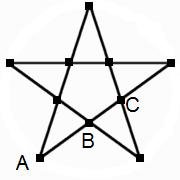
A pentacle consists of 5 straight lines as shown above. A node is where any two of these lines intersect or meet. Therefore, a pentacle has 10 nodes.
That was the notation. Now the interesting part. Assume that a huge pentacle is drawn on the ground, and on each of its nodes, we have a gun with which you can shoot another node that is exactly two hops away. For example, in the figure, you can shoot A from C or vice versa, but you cannot shoot B from either A or C. Once a node has been shot, you cannot use it to shoot at another node. The goal is to start from any node and to keep shooting (only one shot at a time) until only one of the nodes remains. Can it be done? If so, how would you do that?
Hint: The solution to this problem is based on a simple strategy. Can you prove or disprove that this strategy is the only way to solve this problem?
Friday, October 28, 2005
Wednesday, October 05, 2005
Twelve Angry Men
An old man's testimony has the potential to put a youth (the accused) in the electric chair. However, his testimony seems to disagree with certain facts. But why would he lie?
text from:
http://classweb.howardcc.edu/jbell/ideabook/angrymen.pdf
"...Juror #9 then said that he had watched the old man for a long time in court. He noticed that he had a tom jacket and walked dragging a leg. He believed that the old man had never had any recognition, that nobody knew him, and that it was a sad thing to be nothing, so maybe he made himself believe it for his "15 minutes of fame". Juror #5 then changed his vote to not guilty..."
In the entire movie, I found this to be the most astute bit of reasoning. Why? Because very few people can perceive and interpret human nature as it is. It may not be easy to commit murder, but it is incredibly easy for an unfulfilled person to push a man to the guillotine for "15 minutes of fame". Doesn't the person feel guilty? Of course not! He has wiped out all memory, and overwritten it with belief. Why should he care for a world that does not care for him?
text from:
http://classweb.howardcc.edu/jbell/ideabook/angrymen.pdf
"...Juror #9 then said that he had watched the old man for a long time in court. He noticed that he had a tom jacket and walked dragging a leg. He believed that the old man had never had any recognition, that nobody knew him, and that it was a sad thing to be nothing, so maybe he made himself believe it for his "15 minutes of fame". Juror #5 then changed his vote to not guilty..."
In the entire movie, I found this to be the most astute bit of reasoning. Why? Because very few people can perceive and interpret human nature as it is. It may not be easy to commit murder, but it is incredibly easy for an unfulfilled person to push a man to the guillotine for "15 minutes of fame". Doesn't the person feel guilty? Of course not! He has wiped out all memory, and overwritten it with belief. Why should he care for a world that does not care for him?


Subscribe to:
Posts (Atom)